Rodent control addresses the dual pressure of suburban density and equestrian agricultural acreage across Palm Beach County. Roof rats (Rattus rattus) exploit mature palm canopies and tile roof overlaps in planned…
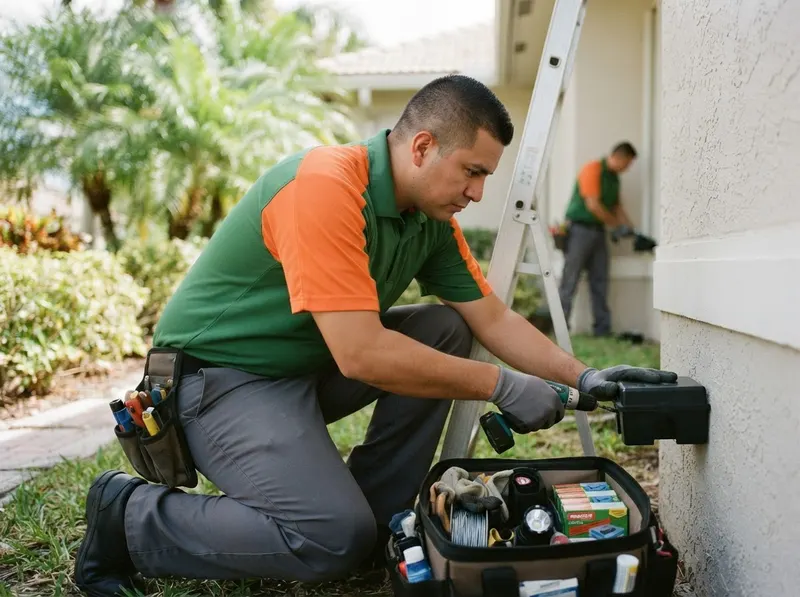
Rodent control addresses the dual pressure of suburban density and equestrian agricultural acreage across Palm Beach County. Roof rats (Rattus rattus) exploit mature palm canopies and tile roof overlaps in planned developments such as Olympia, Versailles, and Sugar Pond Manor, entering soffits through gaps as narrow as 0.5 inches. In acreage communities like Palm Beach Point, Grand Prix Village, and the Wellington Aero Club, feed storage buildings and barn tack rooms attract Norway rats (Rattus norvegicus) and field mice that seek indoor nesting grounds during the subtropical rainy season. Resolving an active intrusion requires identifying gnaw marks on PVC plumbing pipes, grease rub marks along wall studs, and droppings measuring 0.25 to 0.5 inches in attic insulation near Tiger Shark Cove Park and the Mall at Wellington Green.
Selecting professional exclusion over standard retail snap traps or toxic interior loose baits prevents dead rodents from decaying within drywall cavities. Structural exclusion seals foundation vents, roof valleys, and AC chase lines using 16-gauge quarter-inch galvanized steel mesh and non-shrink polyurethane sealant, which rodents cannot chew through. When property owners choose exterior perimeter bait stations paired with interior mechanical trapping rather than interior chemical broadcast poisons, they protect domestic dogs, barn cats, and competition horses from accidental secondary ingestion. The structural trade-off involves prioritizing permanent physical sealing over temporary chemical knockdown, ensuring animals cannot re-enter once the interior population reaches zero.
Rodent remediation follows three chronological phases. First, technicians inspect rooflines, fascia boards, foundation crawlspaces, and pipe penetrations across properties bordering Binks Forest and Greenview Shores to record all active and potential entry portals. Second, crews install custom physical barriers over every opening exceeding 0.25 inches and place numbered mechanical traps inside locked attic vaults, checking trap lines on scheduled 3-to-5-day intervals. Third, once zero attic activity is confirmed over a consecutive 10-day period, technicians apply an antimicrobial, EPA-registered enzymatic mist to sanitize fecal deposits and remove pheromone trails that attract future colonies.
Every job gets a firm, written price after a free on-site visit.
Tell us about your rodent control job in Wellington and we'll send a clear, written quote, usually the same day.
 Wild Basin Pest Control